.jpg)


How to Grow & Harvest Rhubarb - How to Force Rhubarb

Updated: Jun 10
I love growing rhubarb in my backyard, partly just because I love the look of the plant! I feel like it is one of the few plants that looks similar to a tropical plant and grows amazingly well in zone 3 gardens and backyards. Not only do I love cooking with it, I think it is a beautiful plant.

Our family's original rhubarb root came from a rhubarb plant that belonged to my husband's grandma. I love how rhubarb is one of those things that can be passed down generation to generation.
One of the first plants to poke it's head through the cold ground and also one of the first to harvest, rhubarb is a must have for any of us northern gardeners. (Okay, okay, unless you hate it. But then why are you reading this? Haha.)
Other bonuses to growing rhubarb besides the fact that it is super hardy and loves the climate of zone 3 gardens are the facts that it is low maintenance, it is deer resistant, and once established rhubarb requires almost no care yet will continue to produce year after year.
Although rhubarb can be grown from seed, most of the time it is grown from root. If you ask around you may be able to find a friend who is willing to split their rhubarb plant and give you a section of root.
Fun fact: did you know rhubarb, although often thought of as a fruit, is actually a vegetable?
When to Divide Rhubarb
The best time to divide and to plant rhubarb is in the fall or early spring. If it is fall, cut all stems and leaves off the piece you plan to plant, if dividing a plant. In early spring a section of rhubarb root can be removed with the crown of the plant intact.
How to Plant a Rhubarb Root
The best soil for rhubarb is going to be a loose soil high in nitrogen. Nitrogen promotes the stem and leaf growth of the plant. Mix in some compost or aged manure as you are preparing your soil for your new plant.
The rhubarb root should include a portion of crown. To plant a rhubarb root, dig a hole, set the root in place with the crown just at soil level and press in soil firmly around the root of the plant. Do not cover the crown with soil. Planting too deep will most likely kill the plant. Water well after planting, and for the first year plan to water the rhubarb plant weekly.

A rhubarb plant just poking up from the ground on April 20th in my garden near Calgary, AB.
When to Harvest Rhubarb
Rhubarb is sweetest when harvested in the spring or the fist half of the summer, although you can harvest from it all summer long. Towards the end of the summer the rhubarb stocks do not contain as much moisture and they can become dry and woody.
To allow the plant to grow stronger and establish well during the first year, do not harvest. Once your rhubarb plant is on it's second year you can begin to harvest from the plant. Never harvest more than 1/3 of the plant at a time, allowing it to fill in again for a week or two between harvests.
How to Harvest Rhubarb
The best way to harvest rhubarb is to gently pull and twist each stem until it pops out. This is said to be easier on the plant than cutting rhubarb and to encourage more growth quickly. Knowing this, I still sometimes cut rhubarb and the plant is so resilient it does well anyway.

Forcing Rhubarb
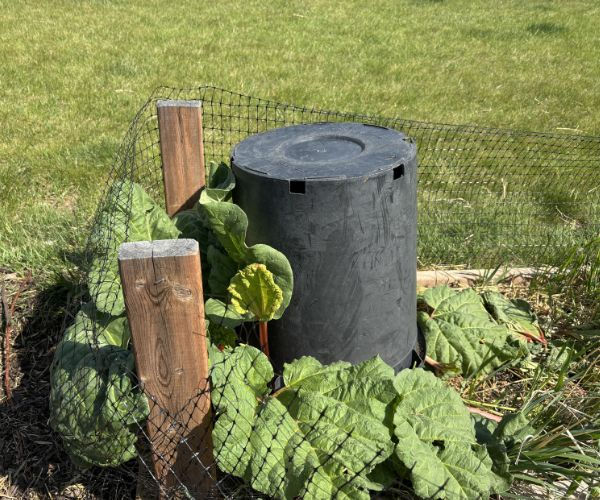
It has become a modern trend to "force" rhubarb. You do this by putting something (like a bucket) that does not allow light in over the rhubarb crown in early spring. The plant will quickly grow sweet and tender stalks as they push and reach to find light.
I am so pleased with the results of doing this, having tried it for the first time this spring. If was able to harvest rhubarb before the end of May! I found the rhubarb DID indeed taste sweater and it was not stringy at all when I was chopping it up. Instead it was very tender and juicy.
How to force rhubarb:
Only force rhubarb plants that have been established for 3 years or more
Select a 5 gallon pail or large pot
Cover no more than 3/4 of the plant just as it begins to form leaves early in the spring (early May for me)
Leave this cover over the rhubarb for about 3 weeks
Remove when you see the rhubarb begin to push the cover up off the ground
Harvest and enjoy extra early, tender and sweet rhubarb!